Dear Fellow Art Lovers,
In this episode of “Art with Feeling”, which was recorded just before Valentine’s Day, my husband, Douglas, and I describe and discuss his favourite painting, Arthur Hughes’ stunningly coloured, Pre-Raphaelite inspired, April Love”.
Click here to listen to the podcast.
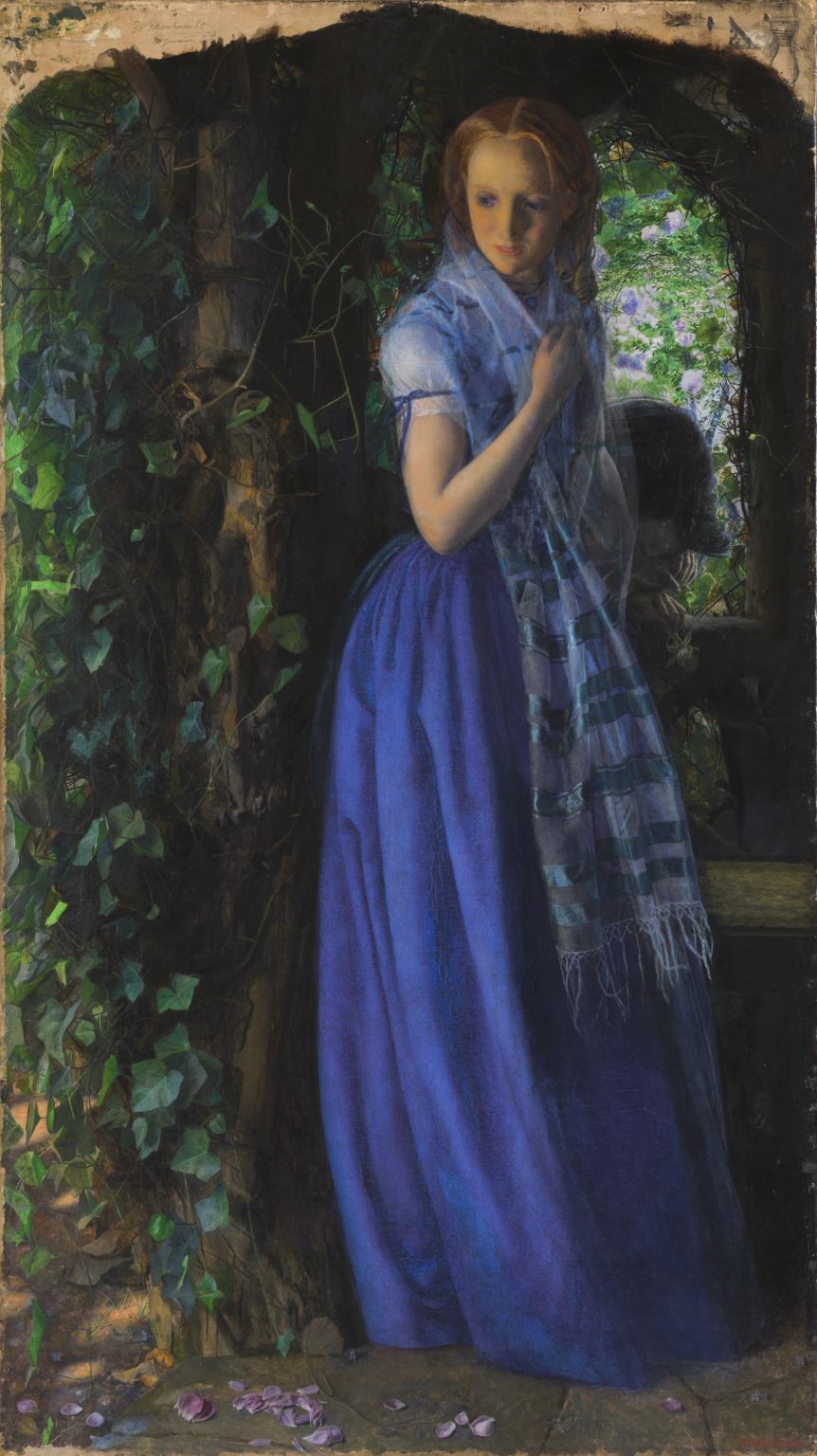
This painting was first shown at the Royal Academy in 1856, less than a year after Arthur Hughes was finally able to marry the woman who he met in 1851 and whom he described as his, “early and only love” Tryphena Ford. It is believed Tryphena was the final model for the lady with the captivating face in “April Love”. According to Margaret Monroe, her brother, Alexander Monroe, the sculptor who in the 1850s shared a studio with Hughes at 6 Upper Belgrave Place, London, was the model for the mysterious lover, “skulking” in the shadows near the ivy-laden arbour or summer house. To Hughes’ great surprise, an Oxford student, who would become the famous designer, William Morris, sent Edward Burne-Jones to purchase “April Love” before anyone else could snap it up. When “April Love” was shown at the Royal Academy, one of two songs from Lord Alfred Tennyson’s poem “The Miller’s Daughter” (1833/42) accompanied the details for the painting in the exhibition catalogue. :
Love is hurt with jar and fret.
Love is made a vague regret.
Eyes with idle tears are wet.
Idle habit links us yet.
What is love? for we forget:
Ah, no! no!
Unlike in many Pre-Raphaelite paintings the picture was not meant to illustrate the poem, rather the lines from the poem augmented the symbols of lost love in the painting, such as the ivy and the fallen rose petals. The other “song” from this poem is often reprinted and also may be eluded to in the painting by the delicate heart-shaped necklace the young woman wears on a ribbon around her neck. The lines to the song which the Squire has sung for the Miller’s Daughter on their wedding day are:
It is the miller’s daughter,
And she is grown so dear, so dear,
That I would be the jewel
That trembles at her ear:
For hid in ringlets day and night,
I’d touch her neck so warm and white.
And I would be the girdle
About her dainty, dainty waist,
And her heart would beat against me,
In sorrow and in rest:
And I should know if it beat right,
I’d clasp it round so close and tight.
And I would be the necklace,
And all day long to fall and rise
Upon her balmy bosom,
With her laughter or her sighs,
And I would lie so light, so light,
I scarce should be unclasp’d at night.
Douglas and I go on to explore how colour and art has helped us to learn more about one another and to observe the world around us in different ways. Finally, we consider what impact sight loss might have on developing relationships, whether romances or friendships. Interestingly, Douglas explains how touch, through me needing him to act as a sighted guide, helped him to get to know me better and feel closer to me, which I found very interesting as I think of being guided as a very practical transaction, and never really considered how it might actually make someone feel more at ease with you and let them get to know you better.
We hope you enjoy. As always, feedback is very much welcomed and appreciated. I would love to hear some of your own experiences sharing art with friends of loved ones and how this might have brought you closer together.
Below are some links which give more details about the painting, Tryphena Ford, and an interesting link to an article about colour which explains the origins of the stunning hue of purple used in “April Love”.
Until next time, best wishes,
Lisa, Douglas, and Star (who makes her presence known at the start of this podcast)
For a look at Tryphena Ford, and just a fun and fascinating blog in general see Kirsty Stonell Walker’s article: http://fannycornforth.blogspot.com/2018/12/thursday-20th-december-tryphena-foord.html
For general background about Arthur Hughes, and details of “April Love” see: https://www.tate.org.uk/art/artworks/hughes-april-love-n02476
For full text of Tennyson’s “The Miller’s Daughter: see: http://www.online-literature.com/tennyson/4067/
In the 1850s there was a fashion for purple, due partly to a dye called murexide made from solidified guano imported from Peru: https://www.philipball.co.uk/articles/colour/51-colour-and-art